
From 18 to 19 of December 2025, the 15th Korea and Japan Youth Exchange Program has held at the Kinpusenji Temple (World Heritage) in Nara Prefecture in Japan. Co-hosted by Korean Conference of Religions for Peace (KCRP) and WCRP/RfP Japan Youth Committee.
Beginning in 1990, this event promotes dialogue and fosters friendship among young religious people from Korea and Japan. It has been held for over 35 years.
Day1
Rev. Yoshiharu Tomatsu, Chair of WCRP/RfP Japan, delivered the welcome speech in the opening session.
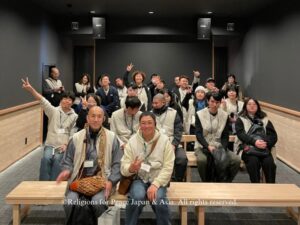
The first day began with participants getting to know each other.
After learning about the venue, Kinpusen-ji Temple, they were given the opportunity to experience Shugendo practices.
Though the climb was brief, it provided a valuable chance to experience the footsteps of Shugendo practitioners.
Participants also actively engaged in cross-cultural exchange, utilizing interpreters and translation apps, deepening their friendships. The bonds formed today will lead to the second day’s dialogue.
You can see more photos on our Instagram (Day1, Day2) or Facebook (Religions for Peace Asia | Facebook).
Day2
The second day of the Korea and Japan Youth Exchange Program began with the morning religious service at Kinpusenji Temple.
Before sunrise, participants gathered at the Zaodo Hall (the main hall) to observe the monks performing their rituals.
After a short break, a goma fire ritual was conducted, with Chief Abbot Yoshitomo Gojo serving as the officiant. Although the ritual is normally held at noon, it was specially conducted in the morning on this occasion.
Abbot Gojo explained, “The goma ritual has continued for more than 1,300 years. In esoteric Buddhism (Shugendo), we do not worship the fire itself. Rather, the flames represent the wisdom of the Tathagata, which burns away the worldly desires within us and purifies our hearts. If each of us can sincerely wish for the happiness and well-being not only of those around us but also of all people we have yet to meet, then world peace may be realized.”
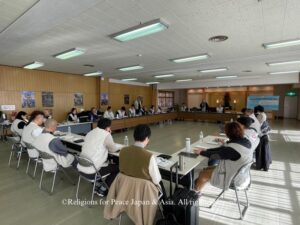
Afterward, participants were divided into three groups for dialogue sessions, where they freely and thoughtfully shared their impressions and discussed future perspectives.
Until the very end, participants were reluctant to part, promising to stay in touch and to meet again in the future.
.
.
Beginning in 1990, this event promotes dialogue and fosters friendship among young religious people from Korea and Japan. It has been held for over 35 years.
Day1
Rev. Yoshiharu Tomatsu, Chair of WCRP/RfP Japan, delivered the welcome speech in the opening session.
The first day began with participants getting to know each other.
After learning about the venue, Kinpusen-ji Temple, they were given the opportunity to experience Shugendo practices.
Though the climb was brief, it provided a valuable chance to experience the footsteps of Shugendo practitioners.
Participants also actively engaged in cross-cultural exchange, utilizing interpreters and translation apps, deepening their friendships. The bonds formed today will lead to the second day’s dialogue.
You can see more photos on our Instagram (Day1, Day2) or Facebook (Religions for Peace Asia | Facebook).
Day2
The second day of the Korea and Japan Youth Exchange Program began with the morning religious service at Kinpusenji Temple.
Before sunrise, participants gathered at the Zaodo Hall (the main hall) to observe the monks performing their rituals.
After a short break, a goma fire ritual was conducted, with Chief Abbot Yoshitomo Gojo serving as the officiant. Although the ritual is normally held at noon, it was specially conducted in the morning on this occasion.
Abbot Gojo explained, “The goma ritual has continued for more than 1,300 years. In esoteric Buddhism (Shugendo), we do not worship the fire itself. Rather, the flames represent the wisdom of the Tathagata, which burns away the worldly desires within us and purifies our hearts. If each of us can sincerely wish for the happiness and well-being not only of those around us but also of all people we have yet to meet, then world peace may be realized.”
Afterward, participants were divided into three groups for dialogue sessions, where they freely and thoughtfully shared their impressions and discussed future perspectives.
Until the very end, participants were reluctant to part, promising to stay in touch and to meet again in the future.
.
.
 English
 Bengali
 Chinese (Simplified)
 Filipino
 Hindi
Hindi Indonesian
 Japanese
 Javanese
 Khmer
Khmer Korean
 Kyrgyz
 Lao
Lao Malay
Malay Mongolian
 Myanmar (Burmese)
 Nepali
 Persian
 Portuguese
 Sinhala
 Tamil
Tamil Thai
Thai Urdu
Urdu