
Strengthening Religions for Peace Mongolia:
Interreligious Cooperation and Peace Advocacy
Ulaanbaatar, Mongolia. Religions for Peace International and Religions for Peace Asia, in partnership with Religions for Peace Mongolia, convened a series of strategic meetings and a High-Level Interreligious Forum from 9 to 11 December 2025 in Ulaanbaatar. The gathering aimed to strengthen Religions for Peace Mongolia’s role in advancing interreligious cooperation, peace advocacy, and shared well-being at the national, regional, and global levels.
Mongolia offers a unique and fertile ground for interreligious collaboration. Rooted in a long tradition of religious tolerance and pluralism—where Buddhism coexists alongside Muslim, Christian, Shamanist, and other faith traditions—the country provides important lessons for peaceful coexistence. Across the meetings, participants highlighted opportunities for collaboration in social service, education, cultural heritage preservation, environmental protection, and peacebuilding.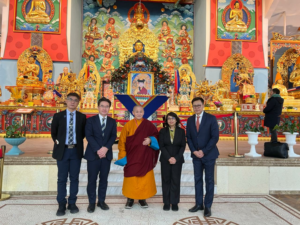 High-Level Engagements with Government and Religious Leaders
The international delegation—Ms. Deepika Singh, Deputy Secretary General of Religions for Peace International; Rev. Dr. Yoshinori Shinohara, Secretary General of Religions for Peace Asia; and Prof. Pablito A. Baybado, Jr., Associate Secretary General of Religions for Peace Asia—met with leaders of Religions for Peace Mongolia Dr. Gavj Bulgan Tumeekhuu, Secretary General, Dr. Lkhagvademchig Jadamba, Associate Secretary General, and Dr. Jalsraijamts Ganbaatar, Youth Secretary. and engaged government officials, senior religious leaders, and leading academics.
During a meeting with Hon. Dulam Bum-Ochir, Adviser to the President of Mongolia on Cultural and Religious Policy, discussions underscored Mongolia’s historic legacy of religious freedom, dating back to the Mongol Empire and the spirit of Pax Mongolica. The Adviser emphasized that religious tolerance remains a cornerstone of Mongolia’s national identity and positions the country as a meaningful contributor to global peace efforts.
The meeting also explored future collaboration, including the possibility of hosting regional Religions for Peace meetings in Mongolia and supporting high-level interreligious dialogue initiatives in preparation for the upcoming 10th Asian Conference of Religions for Peace (ACRP) General Assembly.
Deepening Interfaith Solidarity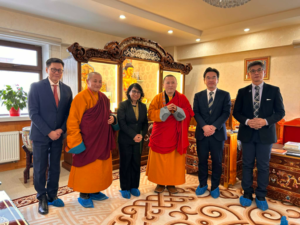 The delegation met with His Eminence Geshe Lhaaramba D. Javzandorj, Head Abbot of Gandantegchenling Monastery, the Center of Mongolian Buddhists. His Eminence shared the monastery’s active role in interreligious dialogue, including the organization of a national interfaith assembly and participation in Vatican interreligious meetings with Pope Francis in 2024. Emphasizing that dialogue must lead to action, he highlighted peacebuilding and environmental stewardship as shared priorities among faith communities.
The visit to the Apostolic Prefecture of the Catholic Church in Mongolia further illustrated faith-based service in action. Despite being a small community, the Catholic Church plays a vital role in social outreach, including the House of Mercy, which provides food, hygiene facilities, and medical assistance to marginalized and homeless individuals.
High-Level Interreligious Forum on Harmony and Collaboration
A highlight of the program was the High-Level Interreligious Forum held on 10 December 2025 at Gandantegchenling Monastery. Bringing together leaders from Buddhist, Muslim, Christian, Shamanist, Baha’i, and other traditions, as well as prominent scholars, the forum provided space for reflection, dialogue, and collective discernment.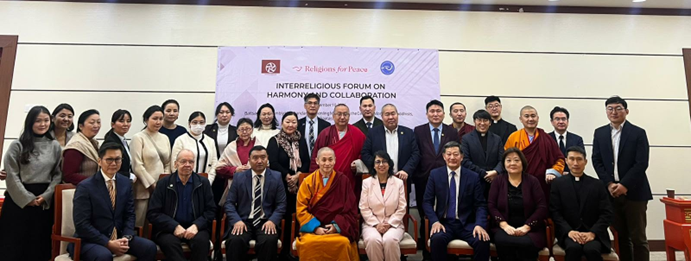
Speakers emphasized the moral authority of religious leaders to promote peace, address polarization, respond to climate challenges, and support vulnerable communities. The forum stressed that interreligious dialogue must move beyond conversation toward coordinated action grounded in shared values.
Key Discussion Themes
Across three thematic sessions, participants explored:
- Mongolia’s experience of multi-religiosity, highlighting practical models of interfaith cooperation in peace education, youth engagement, and community service;
- Contemporary challenges to interreligious harmony, including social change, legal frameworks, and the need for education and public awareness; and
- The role of multi-religious collaboration in advancing shared sacred well-being, focusing on translating harmony into collective action, strengthening institutional partnerships, and promoting inclusive narratives for social cohesion.
Looking Ahead
The meetings concluded with a strong affirmation of Mongolia’s important role in advancing interreligious cooperation. Participants committed to strengthening partnerships within the Religions for Peace network and to using upcoming regional and global platforms—particularly the 10th ACRP General Assembly—to translate shared commitments into concrete peacebuilding initiatives.
Overall, the gathering demonstrated that multi-religious collaboration is not only possible, but essential for fostering peace, social cohesion, and sustainable well-being in Mongolia and beyond.
To read in PDF, click >>> RfP Mongolia Newsletter
.
.
 English
 Bengali
 Chinese (Simplified)
 Filipino
 Hindi
Hindi Indonesian
 Japanese
 Javanese
 Khmer
Khmer Korean
 Kyrgyz
 Lao
Lao Malay
Malay Mongolian
 Myanmar (Burmese)
 Nepali
 Persian
 Portuguese
 Sinhala
 Tamil
Tamil Thai
Thai Urdu
Urdu